
Economic Scan - Alberta: 2026
Demographics

Highlights
- In 2025, employment among Alberta's working age population (ages 15 to 64) increased by 2.9% to more than 2.4 million people. Their unemployment rate increased 0.3 percentage points to 7.4%.
- Youth (ages 15 to 24) made up 18.8% of the working age population in 2025. The unemployment rate for young people was 15.7% in 2025, a 1.2 percentage point increase from 2024.
- Seniors (aged 65 and over) represented 15.5% of Alberta's total population in 2025, compared to 19.4% across Canada.
- Alberta has a slightly younger population than Canada with a median age of 38.1 compared to the national median of 40.6.
Over 5.0 million people lived in Alberta in 2025, an increase of 2.4% from 2024. The province accounted for 12.1% of Canada's total population.
Indigenous people living off reserve comprised 5.4% of the total provincial population (15 years and over) in 2025. Their participation rate (66.1%) and employment rate (58.9%) were lower than those of the total provincial population. The unemployment rate for Indigenous people living off reserve was also higher at 10.9%, compared to the provincial rate of 7.2%.
In 2025, nearly a third of Alberta's population (32.8%), was a part of a visible minority. Alberta's visible minority population was predominantly South Asian (29.3%), followed by Filipino (17.6%), and Black (14.2%). Alberta had the second highest proportion of visible minorities among the Western Provinces.
In 2025, landed immigrants represented 27.0% of Alberta's population (15 years and over). Their population grew to 1,095,000, an increase of 0.9% when compared to 2024. The unemployment rate of landed immigrants was 7.2%, equal to the provincial rate.
In 2024, the unemployment rate for persons with disabilities (ages 15 - 64) was 7.8% compared to 6.0% for persons without a disability (ages 15 – 64). In addition, their participation rate was 73.3%, which was much lower than that of persons without disabilities at 82.9%.
Source: Statistics Canada — Labour Force Survey and Labour Market Socioeconomic Indicators (2024).
Labour Market Conditions
In 2025...
Employment increased (+2.8%)
Unemployment rate increased (+0.2pp)
Participation rate decreased (-0.3pp)
Employment rate decreased (-0.5pp)

Show data table
| Year | Unemployment Rate (%) |
|---|---|
| 2015 | 6.1 |
| 2016 | 8.2 |
| 2017 | 8.0 |
| 2018 | 6.5 |
| 2019 | 6.9 |
| 2020 | 11.4 |
| 2021 | 8.6 |
| 2022 | 5.8 |
| 2023 | 5.9 |
| 2024 | 7.0 |
| 2025 | 7.2 |
- In 2025, Alberta's unemployment rate increased by 0.2 percentage points to 7.2%. Over the year, the number of unemployed people in Alberta increased to 200,900 (+6.1%).
- The provincial labour force increased by 3.0% in 2025, despite fewer immigrants and interprovincial migrants having moved to the province when compared to 2024.
- In 2025, men made up 50.6% of Alberta's working age population (15–64 years), and employment among men increased by 3.7% year-over-year. In comparison, employment among working age women rose by 2.0% over the same period.
Economic Conditions
Alberta's Economic Drivers in 2025
Population growth
Increased oil and gas sector production
Increased housing starts
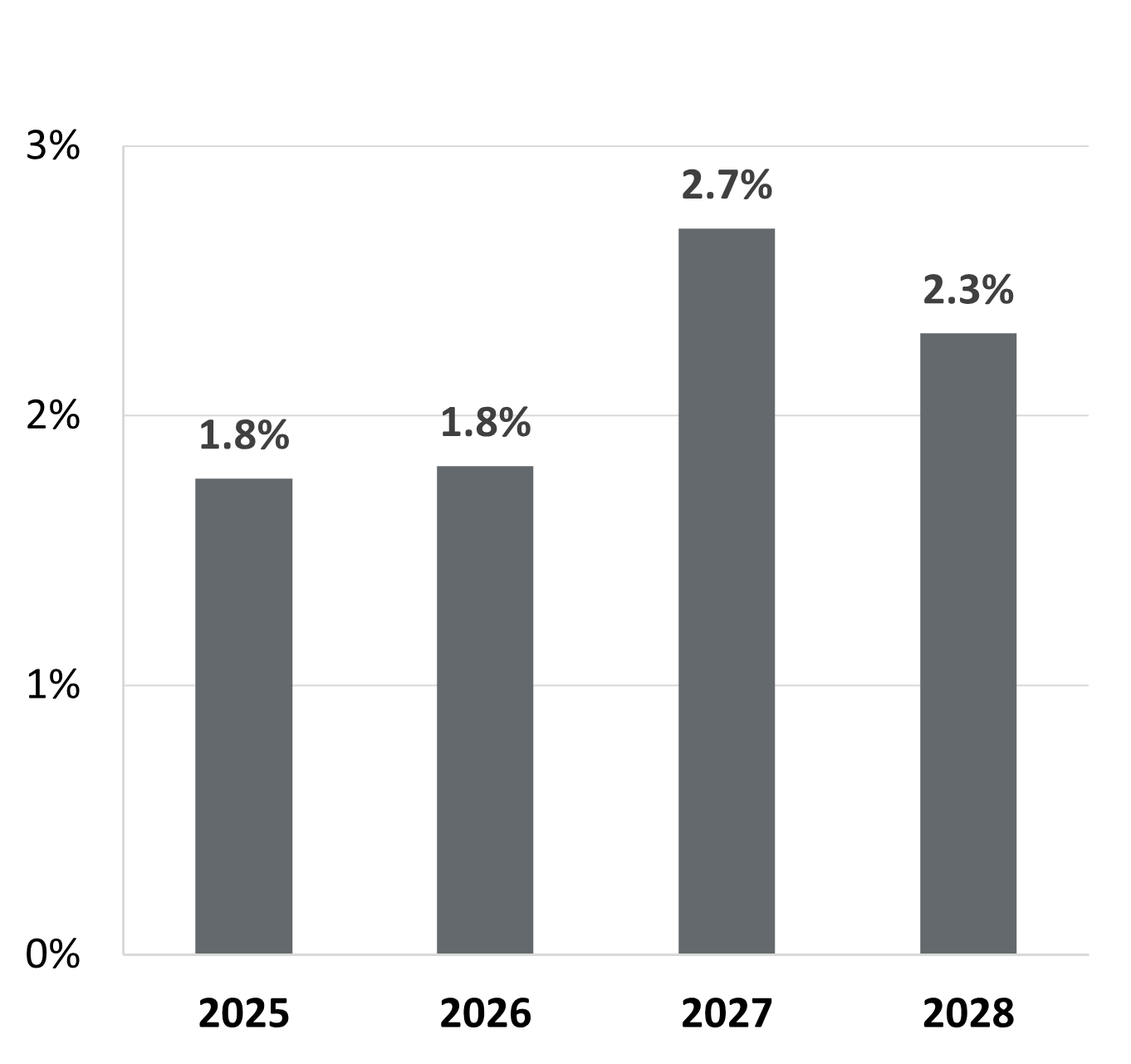
Source: Signal49 Research. Provincial Five-Year Outlook. October 2025.
Show data table
| Year | Forecasted GDP Growth Rate in Alberta |
|---|---|
| 2025 | 1.8% |
| 2026 | 1.8% |
| 2027 | 2.7% |
| 2028 | 2.3% |
Reviewing 2025...
- Employment growth had difficulty keeping up with a growing labour force. Alberta's unemployment rate (7.2%) was greater than the national average (6.8%) for 2025.
- Oil production increased to more than 4 million barrels per day in 2025, of which most of the oil came from the oil sands. 1 , 2
- Despite U.S. tariffs, Alberta's economy showed resilience as employment rose in most industries. Employment increased mainly in the services-producing sector, while the goods-producing sector only experienced slight growth due to job losses in manufacturing as well as mining, quarrying and oil and gas extraction.
- The tourism sector recorded strong growth in 2025 as more Canadians and international visitors choose Alberta as a destination to visit.
Risks to the Alberta Economy in 2026
- Fewer housing starts are anticipated for 2026, as the provincial population growth is expected to slowdown and the housing supply is expected to align more closely with demand.
- Ongoing uncertainty around U.S. tariffs will continue to have a negative impact on Alberta's economy. In addition, persistent low oil prices could affect the province's resource revenue.
- Prolonged labour market challenges, such as the labour force growing more rapidly than employer demand, may continue to drive up the unemployment rate.
Regional Issues
Migration
A resilient economy and affordable cost of living continue to make Alberta an attractive destination for interprovincial migrants. In 2024/2025 net interprovincial migration to Alberta was 28,138.
Industry Trends

Show data table
| Industry (NAICS) | Employment Change ('000s) | Percent Change (%) |
|---|---|---|
| Construction | +12.8 | +5.2 |
| Health care and social assistance | +12.4 | +3.8 |
| Finance, insurance, real estate, rental and leasing | +12.0 | +9.0 |
| Public administration | +10.0 | +8.2 |
| Accommodation and food services | +10.0 | +6.9 |
| Professional, scientific and technical services | +7.9 | +3.3 |
| Transportation and warehousing | +7.4 | +5.1 |
| Wholesale and retail trade | +7.1 | +2.0 |
| Educational services | +6.1 | +3.6 |
| Information, culture and recreation | +5.6 | +6.5 |
| Utilities | +2.0 | +9.6 |
| Agriculture | +1.7 | +4.7 |
| Business, building and other support services | -1.0 | -1.2 |
| Manufacturing | -3.9 | -2.5 |
| Other services (except public administration) | -8.7 | -8.2 |
| Forestry, fishing, mining, quarrying, oil and gas | -10.0 | -6.5 |
- The construction industry added 12,800 jobs in 2025 due to an increase in residential construction and several large-scale projects underway across the province.
- Employment in the forestry, fishing, mining, quarrying, and oil and gas extraction industry decreased by 10,000 jobs in 2025. This was due in part to some companies in the oil and gas sector having reduced costs and restructured operations.
- The health care and social assistance sector added 12,400 jobs in 2025. The industry was supported by Alberta's 2025 provincial budget which placed significant focus on increasing the workforce in this sector.
Regional Economic Conditions
- Most economic regions (ER) in Alberta demonstrated moderate job growth amidst economic uncertainty. Only the Lethbridge-Medicine Hat and Banff-Jasper-Rocky Mountain House and Athabasca-Grande Prairie-Peace River ERs experienced job losses in 2025.
- The Calgary region led the province in employment growth, adding 37,200 jobs in 2025.
- The Edmonton region had the highest unemployment rate in the province at 7.7%, as 73,800 people were unemployed in 2025, an increase of 5,400 (+7.9%) when compared to 2024.
Employment Change by Economic Region, 2025

Show data table
| Economic Region | Percent Change (%) | Employment Change ('000s) |
|---|---|---|
| Red Deer | +6.5 | +7.5 |
| Camrose-Drumheller | +5.0 | +5.2 |
| Edmonton | +3.9 | +33.2 |
| Calgary | +3.7 | +37.2 |
| Wood Buffalo-Cold Lake | +3.0 | +2.3 |
| Alberta | +2.8 | +71.2 |
| Lethbridge-Medicine Hat | -2.2 | -3.6 |
| Banff-Jasper-Rocky Mountain House and Athabasca-Grande Prairie-Peace River | -5.4 | -10.7 |
Endnotes
-
Alberta Energy Regulator Supply and Disposition of Crude Oil and Equivalent (Accessed February 26, 2026). ↑
-
Alberta Energy Regulator Supply and Disposition of Natural Gas (Accessed February 26, 2026). ↑
Page details
- Date modified: